Reframing public safety from individual vigilance to shared systems responsibility.
People do not experience the same street in the same way. A place that feels ordinary to one person can feel unsafe to another depending on their gender identity, the time of day, who else is present, and whether support is available. Yet public-safety responses often focus on locations, or ask individuals to stay alert, avoid certain routes, and protect themselves.
This research examined how people across gender identities experienced and responded to safety in Columbus’s University District. The findings led to a framework for shared responsibility, showing how people, services, digital systems, and infrastructure can work together before and after risk occurs. I used the research to support public-safety, accessibility, and community-experience discussions within The Ohio State University Senate and the University Area Commission.

Safety is relational, not merely spatial
The first set of visualizations examines what created safety, what created unease, where those feelings occurred, and why. Read together, they show that safety depended not only on the physical setting, but also on time of day, social presence, familiarity, visibility, and access to support. The same place could therefore feel very different as the surrounding conditions changed.
What helps people feel safe?
What makes people feel unsafe?
Where do people feel unsafe?


Why do these places feel unsafe?

People experience and respond to risk differently
The next set of visualizations compares how participants understood and responded to unsafe situations. The patterns do not suggest that everyone within a gender group behaves in the same way. Instead, they reveal recurring differences in perceived threats, access to support, and the strategies people used to regain control. This matters because a single safety intervention may support one group while leaving another group’s needs unresolved.
How do cis and trans women respond to unsafe environments?

How do cis and trans men respond to unsafe environments?

How do non-binary and agender individuals respond to unsafe environments?

What is shared, and what differs, across gender identities?
Viewed side by side, the responses reveal which safety needs recur across groups and which depend more strongly on identity or context. This comparison helps distinguish where shared interventions may be appropriate and where more targeted, identity-aware support is needed.


Safety responsibility can shift from individuals to systems
After reflecting on their current experiences, participants were asked to imagine how safety could work differently. Their ideas ranged from personal tools used in the moment to services and environmental systems designed to anticipate risk. Together, the concepts make a larger opportunity visible: safety does not have to depend primarily on individual vigilance. Institutions, technologies, services, and infrastructure can carry more of that responsibility.
Participants’ concepts moved beyond personal safety tools toward environmental, service-based, and anticipatory responses. Mapping these ideas across personal–environmental and reactive–proactive dimensions revealed where institutions could assume greater responsibility before harm occurs. The concepts were therefore not treated as final products, but as evidence of how people believed safety responsibilities should be redistributed.
How did participants imagine safer environments?


Participant-imagined safety interventions
These concepts are not final product proposals. They are research artifacts that make participants’ priorities visible: what kind of support they wanted, when they expected it to appear, and whether responsibility should sit with the individual or with the surrounding system.

An urban system with illuminated paths (i.e., the straws) to increase nighttime visibility and reduce fear of dark pockets. It also has small, mobile robots that individuals can summon on demand to walk with them. It falls within the Environmental- Proactive quadrant. 
A porcupine-inspired wearable accessory, the PorcuHat is a self- defense hat attachment that releases deterrent spikes when a threat is detected. It falls within the Personal-Reactive quadrant. 

An AI-Enabled Urban System with sound-detection walls, threat-assessing AI, GPS tracking and emergency dispatch capabilities to deter noise disturbances. It falls within the Environmental-Reactive quadrant. 
A pocket-sized device that projects hyper-realistic holograms of friends to accompany someone walking alone. It falls within the Personal-Proactive quadrant. 

A pair of stylish glasses equipped with AI capabilities to detect, identify, and communicate threats related to sound and visibility. 
A temporary, swipe-activated pop-up bus shelter, called the Sprout Stop, designed to appear only when needed and then retract back into the ground to avoid misuse or loitering. 


Mapping the current landscape and participant futures


The horizontal axis moves from personal to environmental, indicating where responsibility is located. The vertical axis moves from reactive to proactive, showing whether a concept responds to an immediate concern or anticipates conditions before harm occurs.
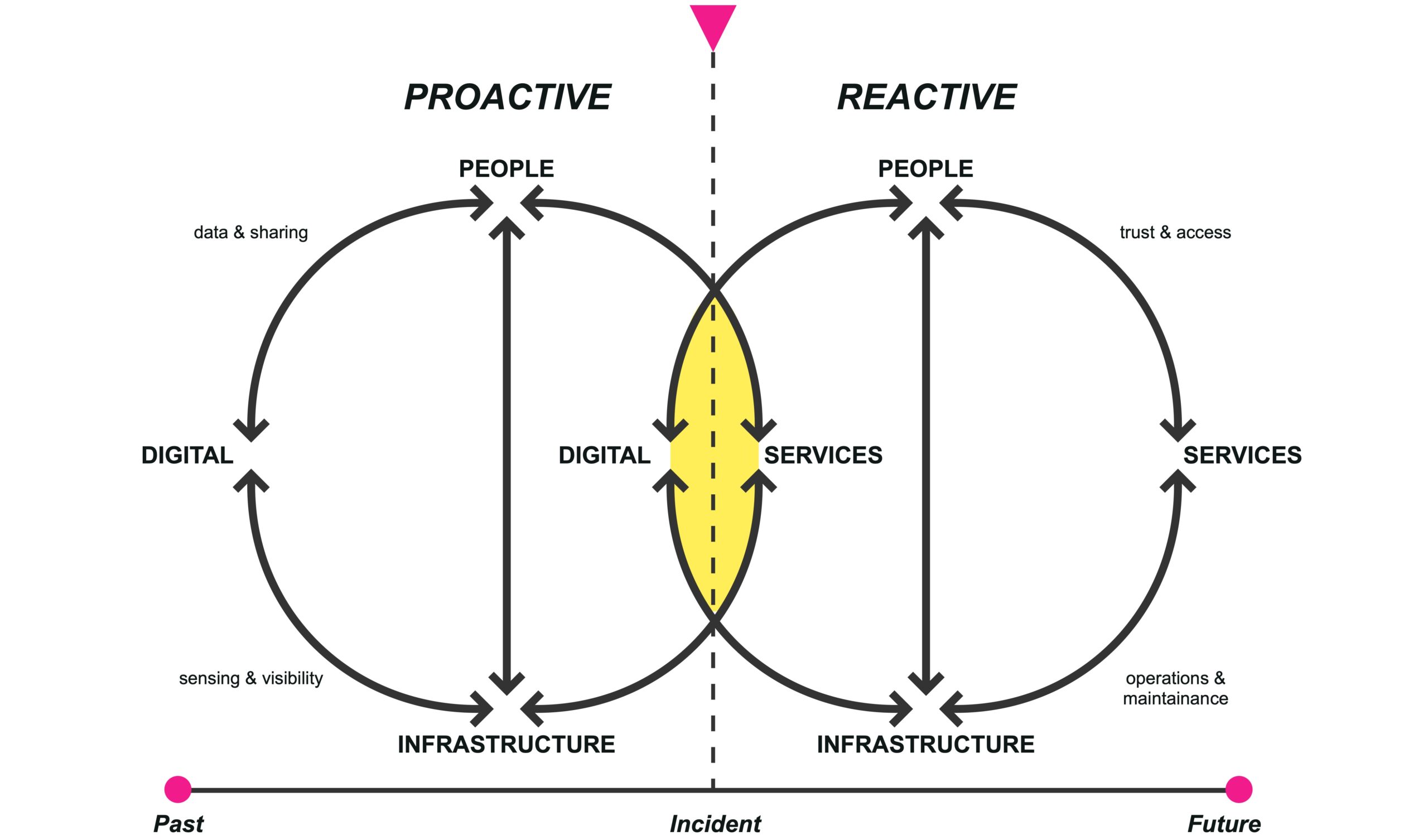
A framework for shared safety responsibility
How people, services, technology, and infrastructure work together across time
The matrix above identifies where individual interventions sit. The framework below shows how those interventions operate as part of a larger safety system. It connects four interdependent layers: people, services, digital systems, and infrastructure, with the periods before and after an incident. This helps decision-makers ask not only what should be introduced, but who should be responsible, when support should appear, and how a change in one layer affects the others.

Before an incident, the system can anticipate risk through social presence, maintenance, communication, and environmental support. After an incident, it can coordinate access, information, response, and recovery. The framework does not prescribe one universal solution. It reveals where responsibility is missing or concentrated, and where coordinated interventions could reduce the burden placed on individuals.
The opportunity: Move from isolated tools that help individuals respond to danger toward coordinated systems that anticipate risk, distribute responsibility, and support recovery.
Methodology


